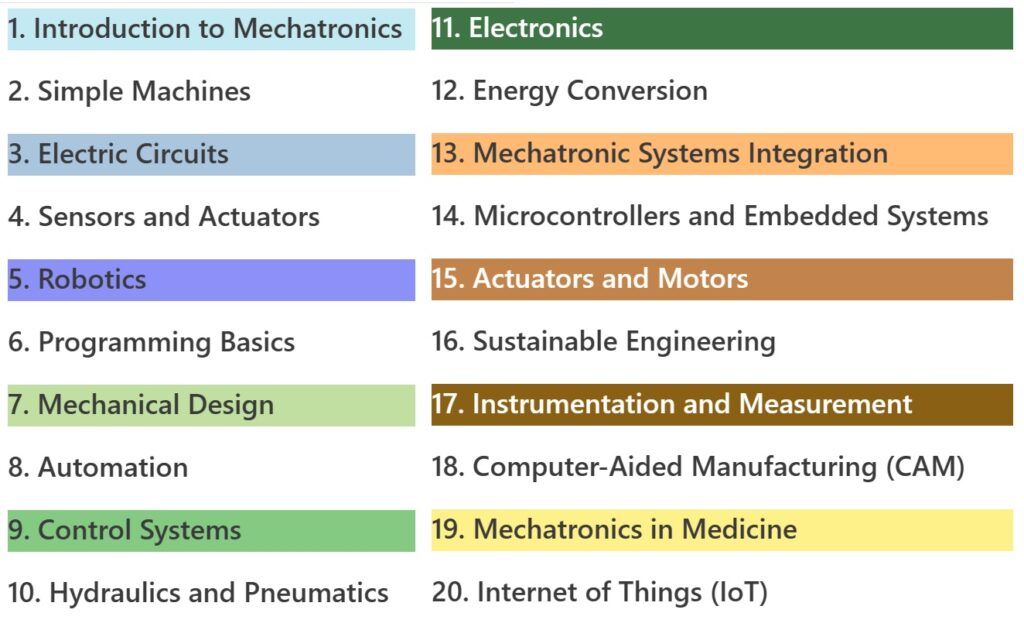
Click the simple table below to view the FULL LENGTH Mechatronics Course for Teens OVERVIEW
DISCLAIMER – This course is put together from various sources. Although the content of the course, and the questions are written and designed by Total Electrical Training, however none of the video tutorials in this course are made by us, or anyone affiliated with us. Although we’ve compiled the videos to enhance your learning of the relevant lesson, this does not mean Total Electrical Training is validating or promoting the creators of those videos or the content of their channels.
This Lessons Contains: READING, VIDEOS, QUESTIONS, and A HANDS ON PROJECT.
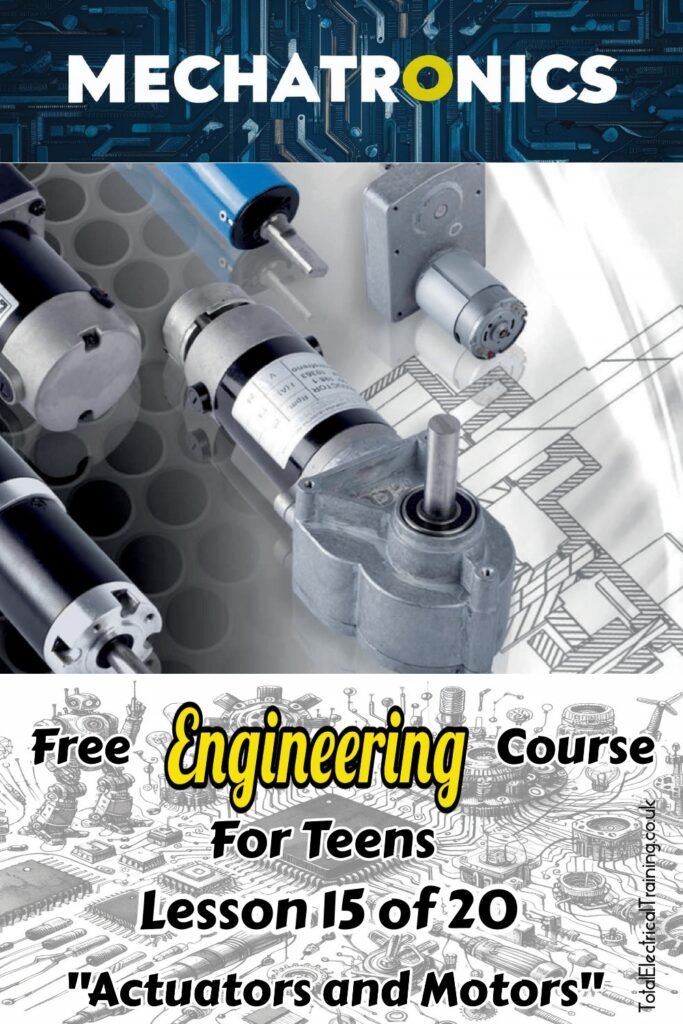
Actuators and Motors: An In-depth Exploration
In the realm of mechanical and electrical engineering, actuators and motors play crucial roles in a myriad of applications, from industrial machinery to everyday household appliances. Understanding these components is fundamental for anyone involved in engineering, automation, and mechatronics. This article delves into the intricacies of actuators and motors, providing detailed answers to key questions about their functions and applications.
What is an Actuator?
An actuator is a device that converts energy into motion. It is a critical component in systems that require controlled movement, such as robotics, industrial automation, and vehicular systems. Actuators can utilise various forms of energy, including electrical, hydraulic, and pneumatic, to produce the desired mechanical motion.
There are several types of actuators, each suited to specific applications:
- Electric Actuators: These actuators use electrical energy to produce motion. They are commonly used in applications requiring precise control, such as robotic arms and electronic valves.
- Hydraulic Actuators: These devices use pressurised hydraulic fluid to generate motion. They are powerful and are often employed in heavy machinery, such as construction equipment.
- Pneumatic Actuators: These actuators utilise compressed air to produce motion. They are widely used in automation systems where speed and cleanliness are essential.
Actuators can further be classified into linear and rotary types, depending on the nature of the motion they produce. Linear actuators generate straight-line motion, whereas rotary actuators produce rotational motion.
How Do Electric Motors Work?
Electric motors are devices that convert electrical energy into mechanical energy. They are ubiquitous in modern life, powering everything from household appliances to industrial machinery. The basic principle behind electric motors is the interaction between magnetic fields and electric currents to produce force.
An electric motor consists of several key components:
- Stator: The stationary part of the motor, which generates a magnetic field.
- Rotor: The rotating part of the motor, which is acted upon by the magnetic field to produce motion.
- Commutator: In DC motors, this component switches the direction of the current to ensure continuous rotation.
- Windings: Coils of wire that carry the electric current and generate a magnetic field.
The operation of an electric motor can be summarised in the following steps:
- Current Flow: An electric current flows through the windings, creating a magnetic field around them.
- Magnetic Interaction: The magnetic field generated by the windings interacts with the magnetic field of the stator.
- Force Generation: The interaction between the magnetic fields produces a force that acts on the rotor, causing it to rotate.
- Continuous Motion: In the case of DC motors, the commutator periodically reverses the direction of the current, ensuring continuous rotation.
What are the Differences Between AC and DC Motors?
Electric motors can be broadly classified into two types based on the nature of the current they use: AC (Alternating Current) motors and DC (Direct Current) motors. Each type has distinct characteristics and is suited to different applications.
AC Motors:
- Power Supply: AC motors run on alternating current, where the direction of the current changes periodically.
- Construction: They typically have a simpler construction with fewer components such as brushes and commutators.
- Speed Control: Speed control in AC motors is more complex and usually requires variable frequency drives (VFDs).
- Applications: AC motors are commonly used in applications where a stable speed is required, such as in fans, pumps, and household appliances.
DC Motors:
- Power Supply: DC motors operate on direct current, where the current flows in a single direction.
- Construction: They generally have more components, including brushes and a commutator, which require maintenance.
- Speed Control: Speed control in DC motors is straightforward and can be easily achieved by varying the supply voltage.
- Applications: DC motors are ideal for applications requiring precise speed and position control, such as in robotics and electric vehicles.
In summary, AC motors are favoured for their robustness and low maintenance, making them suitable for industrial and high-power applications. On the other hand, DC motors offer better control and are preferred in applications requiring fine-tuned speed and position adjustments.
How are Motors Controlled in Mechatronic Systems?
In mechatronic systems, precise control of motors is essential to ensure accurate and efficient operation. Various methods and technologies are employed to achieve this control, depending on the type of motor and the specific requirements of the application.
- Open-Loop Control: In this basic form of control, the motor operates at a fixed speed or position without feedback. It is simple and cost-effective but lacks accuracy and adaptability.
- Closed-Loop Control: This method uses feedback from sensors to adjust the motor’s operation in real time. The feedback can come from various sensors, such as encoders for position and speed or torque sensors. Closed-loop control offers higher precision and adaptability.
- Pulse Width Modulation (PWM): PWM is a widely used technique to control the speed and torque of motors, especially in DC motors. It involves varying the width of the pulses in a pulse train to adjust the average voltage supplied to the motor.
- Variable Frequency Drives (VFDs): VFDs are used to control the speed of AC motors by varying the frequency of the supply voltage. They offer precise speed control and can improve the energy efficiency of the system.
- Microcontrollers and Programmable Logic Controllers (PLCs): These devices are used to implement complex control algorithms for motors. They can process inputs from various sensors and execute control strategies to achieve the desired motor performance.
- Field-Oriented Control (FOC): FOC is an advanced control technique used primarily for AC motors, such as induction and synchronous motors. It involves controlling the motor’s magnetic field orientation to optimise torque and efficiency.
In modern mechatronic systems, control strategies often involve a combination of these methods to achieve the desired performance. The choice of control method depends on factors such as the type of motor, the application requirements, and the available budget.
Conclusion
Actuators and motors are indispensable components in a wide range of applications, from simple household devices to complex industrial systems. Understanding their working principles, differences, and control methods is crucial for anyone involved in engineering and automation. Whether you’re dealing with electric actuators, hydraulic systems, or pneumatic devices, the underlying principles remain the same: converting energy into controlled motion. As technology advances, the integration of sophisticated control methods and the development of more efficient motors will continue to drive innovation in mechatronic systems, paving the way for smarter, more responsive machinery.
Hands on Project for this Lesson – Make a Motorized Project
The video below might come in helpful or you can find your own resources to create a motorized project
Questions
- What is an actuator?
- How do electric motors work?
- What are the differences between AC and DC motors?
- How are motors controlled in mechatronic systems?
- Research Question: Research the latest developments in motor technology.
Ready to take a dive into Electrical Engineering to get a head start on College or University, or simply expand your DIY knowledge?
Check out our meticulously designed course in Electrical/Electronic Engineering for all walks of life, from any country. Delivered by Professor F. Tavassoli.

Buy me a Coffee
If this page has been extremely helpful, you can always buy me a digital coffee to express your thanks for the information I’ve put together to help eager minds excel in their knowledge, learning and success.
Your kind donation makes it possible for me to continue creating amazing content, courses and fulfil my dream of keeping the majority of what I make FREE and Ad FREE!!!
Thank you from the bottom of my heart, and abundant blessings to you!
Join students and professionals
from across the world increasing their knowledge of Electrical Engineering.
One email at a time
We never send spam or give your information to anyone, Privacy Policy here.
DISCLAIMER – This course is put together from various sources. Although the content of the course, and the questions are written and designed by Total Electrical Training, however none of the video tutorials in this course are made by us, or anyone affiliated with us. Although we’ve compiled the videos to enhance your learning of the relevant lesson, this does not mean Total Electrical Training is validating or promoting the creators of those videos or the content of their channels.