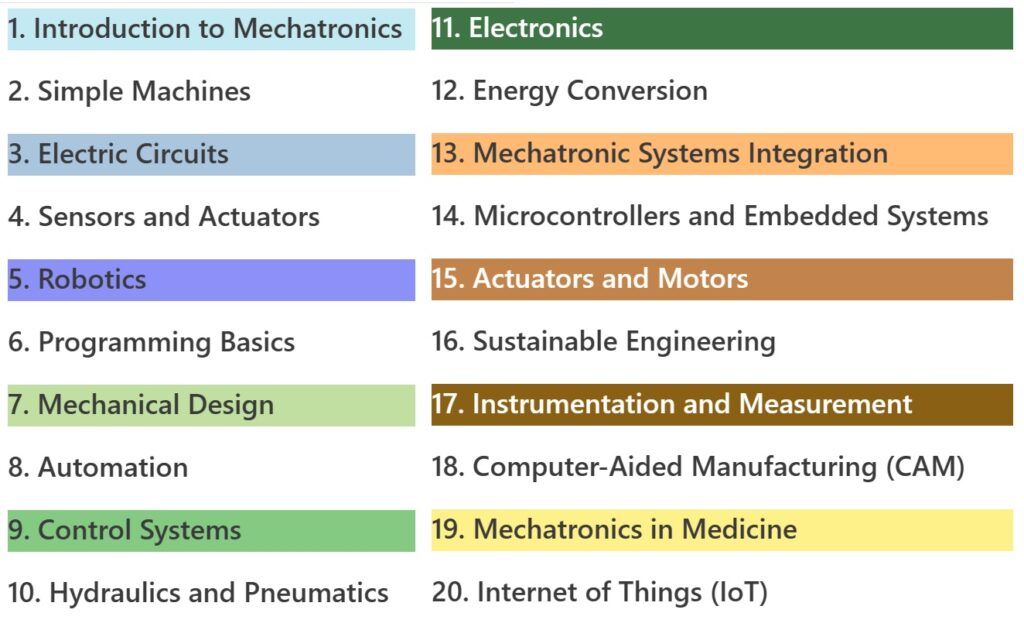
Click the simple table below to view the FULL LENGTH Mechatronics Course for Teens OVERVIEW
DISCLAIMER – This course is put together from various sources. Although the content of the course, and the questions are written and designed by Total Electrical Training, however none of the video tutorials in this course are made by us, or anyone affiliated with us. Although we’ve compiled the videos to enhance your learning of the relevant lesson, this does not mean Total Electrical Training is validating or promoting the creators of those videos or the content of their channels.
This Lessons Contains: READING, VIDEO, and QUESTIONS.
The Internet of Things: A Comprehensive Overview
The Internet of Things (IoT) has become a transformative force in the modern world, connecting devices, systems, and services to enhance everyday life and create new opportunities. This article explores the concept of IoT, its mechanisms, benefits, and the security concerns it poses.
What is the Internet of Things?
The Internet of Things, commonly abbreviated as IoT, refers to a network of physical objects embedded with sensors, software, and other technologies to connect and exchange data with other devices and systems over the Internet. These objects range from everyday household items to complex industrial machinery, making IoT a vast and diverse ecosystem.
At its core, IoT represents the convergence of various technologies, including wireless communication, microelectromechanical systems (MEMS), and the Internet. This convergence has enabled everyday objects to communicate and interact with each other, creating a network of interconnected devices that can collect, share, and analyse data. The concept of IoT has evolved significantly since its inception, and it continues to grow as new technologies emerge.
How Does IoT Connect Different Devices?
The connectivity of IoT devices is achieved through a combination of hardware, software, and communication protocols. Here’s a breakdown of how these components work together to connect different devices:
- Sensors and Actuators: Sensors are the primary components of IoT devices that collect data from the environment. These sensors can measure temperature, humidity, light, motion, and more. Actuators, on the other hand, perform actions based on the data received, such as adjusting a thermostat or turning on a light.
- Connectivity: IoT devices use various communication protocols to transmit data. Common protocols include Wi-Fi, Bluetooth, Zigbee, and LoRaWAN. The choice of protocol depends on factors such as range, power consumption, and data transfer rate. For instance, Wi-Fi is suitable for high-bandwidth applications, while Bluetooth is ideal for short-range communication.
- Edge Devices: Edge devices are intermediaries between IoT sensors and the cloud. They process data locally, reducing the amount of data sent to the cloud and enabling real-time decision-making. Edge computing is particularly useful in applications requiring low latency, such as autonomous vehicles and industrial automation.
- Cloud Platforms: The data collected by IoT devices is often sent to cloud platforms for storage and analysis. These platforms provide scalability, data processing, and machine learning capabilities. Examples of popular cloud platforms include Amazon Web Services (AWS), Microsoft Azure, and Google Cloud.
- Data Processing and Analytics: Once the data is collected and stored, it is processed and analysed to derive insights. Machine learning algorithms can identify patterns and trends, allowing for predictive maintenance, personalised recommendations, and more.
- User Interfaces: Users interact with IoT devices through user interfaces, such as mobile apps, web dashboards, or voice assistants. These interfaces provide control and monitoring capabilities, enabling users to manage their devices remotely.
What Are the Benefits of IoT in Everyday Life?
IoT has brought numerous benefits to everyday life, transforming how we live, work, and interact with the world. Some of the key advantages include:
- Convenience and Automation: IoT devices can automate routine tasks, making life more convenient. For example, smart home devices can adjust lighting, temperature, and security settings based on user preferences. Voice-activated assistants like Amazon’s Alexa or Google Assistant enable hands-free control of devices.
- Energy Efficiency: IoT technology can optimise energy consumption by monitoring and controlling energy usage. Smart thermostats can learn user behaviour and adjust heating or cooling systems accordingly, reducing energy bills. Similarly, smart lighting systems can automatically turn off lights when rooms are unoccupied.
- Improved Healthcare: In healthcare, IoT devices, such as wearable fitness trackers and remote monitoring systems, can track vital signs and provide real-time data to healthcare professionals. This can lead to early detection of health issues and personalised treatment plans. Additionally, IoT-enabled medical devices can ensure timely medication administration and patient monitoring.
- Enhanced Security: IoT devices can improve security in homes and businesses. Smart cameras, doorbell cameras, and motion sensors can provide real-time alerts and remote monitoring. IoT-enabled locks and security systems can be controlled from anywhere, offering peace of mind to users.
- Smart Cities: IoT is playing a crucial role in the development of smart cities. Connected infrastructure, such as smart traffic lights, waste management systems, and environmental sensors, can optimise urban living. For example, smart traffic systems can reduce congestion and improve public transport efficiency.
- Industrial Efficiency: In industrial settings, IoT enables predictive maintenance, asset tracking, and supply chain optimisation. Sensors can monitor machinery and equipment, predicting failures before they occur and reducing downtime. This leads to increased productivity and cost savings.
- Agriculture and Environmental Monitoring: IoT devices are revolutionising agriculture by enabling precision farming. Sensors can monitor soil moisture, temperature, and crop health, allowing farmers to make data-driven decisions. Environmental monitoring systems can track air and water quality, helping to protect natural resources.
What Are the Security Concerns with IoT?
While IoT offers numerous benefits, it also presents significant security challenges. The proliferation of connected devices increases the attack surface, making it essential to address security concerns. Some of the key issues include:
- Data Privacy: IoT devices collect vast amounts of personal data, raising concerns about privacy. If not properly secured, this data can be accessed by unauthorised parties, leading to identity theft, surveillance, or misuse of personal information. Ensuring data privacy requires robust encryption and access controls.
- Device Vulnerabilities: Many IoT devices have limited processing power and memory, making it challenging to implement strong security measures. As a result, they may have vulnerabilities that can be exploited by attackers. Insecure firmware, weak passwords, and lack of regular updates can all contribute to device vulnerabilities.
- Lack of Standardisation: The lack of standardisation in IoT protocols and security practices can lead to inconsistent security levels across devices. Different manufacturers may implement security measures differently, making it challenging to create a cohesive security strategy. Industry standards and best practices are needed to address this issue.
- DDoS Attacks: Distributed Denial of Service (DDoS) attacks can exploit IoT devices to overwhelm networks and disrupt services. Attackers can create botnets by infecting vulnerable devices and using them to launch coordinated attacks. The Mirai botnet attack in 2016, which targeted IoT devices, is a notable example of this type of threat.
- Physical Security: IoT devices are often deployed in physical environments, making them susceptible to tampering or theft. Physical security measures, such as tamper-evident seals and secure enclosures, are necessary to protect devices from unauthorised access.
- Supply Chain Risks: The global supply chain for IoT devices involves multiple vendors and manufacturers. Insecure components or compromised hardware can introduce vulnerabilities into the final product. Ensuring the integrity of the supply chain is crucial to prevent the introduction of malicious code or backdoors.
- Regulatory and Legal Issues: As IoT continues to grow, regulatory frameworks and legal standards are evolving to address security and privacy concerns. Compliance with data protection regulations, such as the General Data Protection Regulation (GDPR) in the European Union, is essential for organisations deploying IoT solutions.
Conclusion
The Internet of Things represents a significant advancement in technology, offering numerous benefits in everyday life and various industries. By connecting devices and enabling data-driven insights, IoT has the potential to transform how we live and work. However, the proliferation of IoT devices also raises security concerns that must be addressed to protect users and their data. As IoT continues to evolve, it is crucial to prioritise security and privacy to fully realise its potential while mitigating risks.
There is no hands on project for this lesson.
Questions
- What is the Internet of Things?
- How does IoT connect different devices?
- What are the benefits of IoT in everyday life?
- What are the security concerns with IoT?
- Bonus: Look into the role of IoT in smart cities.
Ready to take a dive into Electrical Engineering to get a head start on College or University, or simply expand your DIY knowledge?
Check out our meticulously designed course in Electrical/Electronic Engineering for all walks of life, from any country. Delivered by Professor F. Tavassoli.

Buy me a Coffee
If this page has been extremely helpful, you can always buy me a digital coffee to express your thanks for the information I’ve put together to help eager minds excel in their knowledge, learning and success.
Your kind donation makes it possible for me to continue creating amazing content, courses and fulfil my dream of keeping the majority of what I make FREE and Ad FREE!!!
Thank you from the bottom of my heart, and abundant blessings to you!
Join students and professionals
from across the world increasing their knowledge of Electrical Engineering.
One email at a time
We never send spam or give your information to anyone, Privacy Policy here.
DISCLAIMER – This course is put together from various sources. Although the content of the course, and the questions are written and designed by Total Electrical Training, however none of the video tutorials in this course are made by us, or anyone affiliated with us. Although we’ve compiled the videos to enhance your learning of the relevant lesson, this does not mean Total Electrical Training is validating or promoting the creators of those videos or the content of their channels.