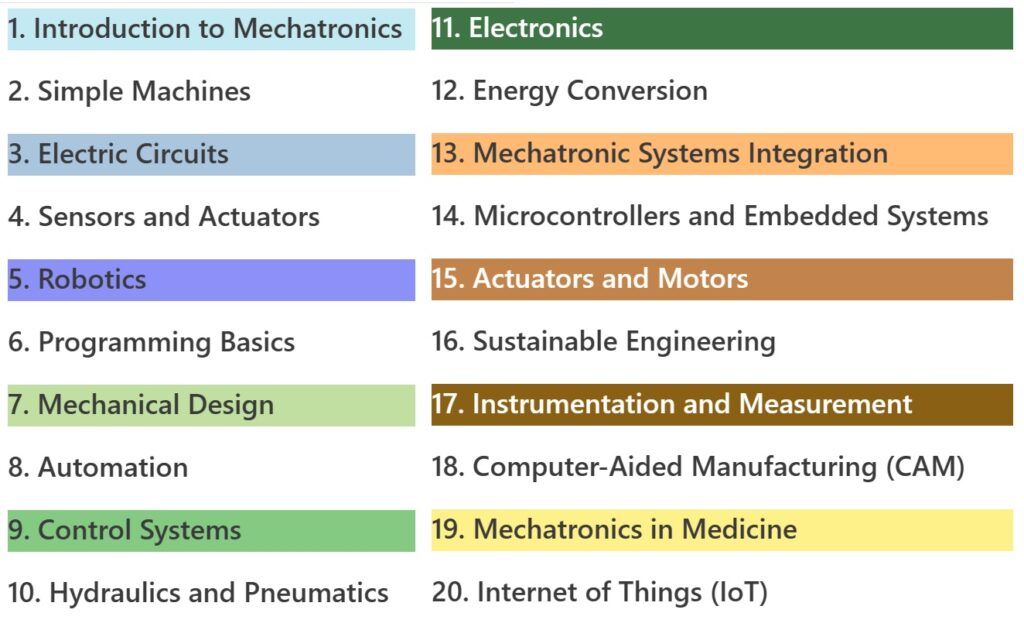
Click the simple table below to view the FULL LENGTH Mechatronics Course for Teens OVERVIEW
DISCLAIMER – This course is put together from various sources. Although the content of the course, and the questions are written and designed by Total Electrical Training, however none of the video tutorials in this course are made by us, or anyone affiliated with us. Although we’ve compiled the videos to enhance your learning of the relevant lesson, this does not mean Total Electrical Training is validating or promoting the creators of those videos or the content of their channels.
This Lessons Contains: READING, VIDEOS, and QUESTIONS.
Mechatronics in Medicine: Transforming Healthcare through Innovation
Introduction
Mechatronics, an interdisciplinary field that combines mechanical engineering, electronics, computer science, and control engineering, has become increasingly significant in the medical field. This synergy of technologies enables the development of advanced medical devices and systems that enhance patient care, diagnostics, and treatment. In this article, we will explore the application of mechatronics in medicine, examine examples of medical devices that utilise mechatronics, delve into how prosthetic limbs mimic natural movement, and discuss the critical role of sensors in medical mechatronics.
Application of Mechatronics in the Medical Field
Mechatronics plays a pivotal role in the medical field by providing the foundation for developing sophisticated medical devices and systems. These systems can perform complex tasks, improve precision, and enhance the safety and efficiency of medical procedures. The integration of mechanical and electronic systems with intelligent control algorithms allows for automated processes, real-time data analysis, and minimally invasive interventions.
One of the most significant applications of mechatronics in medicine is in robotic-assisted surgery. Robotic systems, such as the da Vinci Surgical System, enable surgeons to perform minimally invasive procedures with enhanced precision, dexterity, and control. These systems consist of robotic arms equipped with surgical instruments, controlled by the surgeon through a console. The integration of high-definition 3D vision, advanced control algorithms, and haptic feedback allows for greater accuracy and reduced trauma to patients.
Another crucial application is in medical imaging. Mechatronic systems are used in devices such as MRI scanners, CT scanners, and ultrasound machines. These devices rely on precise mechanical movements and electronic control to generate high-quality images of the body’s internal structures. The integration of mechatronics allows for faster imaging, improved image resolution, and enhanced diagnostic capabilities.
Examples of Medical Devices that Use Mechatronics
Numerous medical devices utilise mechatronics to perform complex functions and improve patient care. Some notable examples include:
- Robotic Surgical Systems: As mentioned earlier, robotic-assisted surgical systems, such as the da Vinci Surgical System, are prime examples of mechatronics in medicine. These systems enable surgeons to perform intricate procedures with enhanced precision and control, leading to smaller incisions, reduced recovery times, and lower complication rates.
- Prosthetic Limbs: Modern prosthetic limbs incorporate mechatronic systems to provide amputees with natural and intuitive movement. These devices use sensors, motors, and microcontrollers to detect muscle signals and translate them into precise movements, allowing users to perform daily activities with greater ease.
- Artificial Organs: Mechatronics plays a crucial role in developing artificial organs, such as artificial hearts and dialysis machines. These devices rely on complex mechanical and electronic systems to replicate the functions of natural organs and provide life-saving support to patients with organ failure.
- Medical Imaging Equipment: MRI scanners, CT scanners, and ultrasound machines use mechatronic systems to acquire high-quality images of the body’s internal structures. These devices rely on precise mechanical movements and electronic control to capture detailed images for accurate diagnosis and treatment planning.
- Wearable Health Monitors: Wearable devices, such as smartwatches and fitness trackers, incorporate mechatronic systems to monitor vital signs, track physical activity, and provide real-time health data. These devices use sensors, microcontrollers, and wireless communication to collect and transmit data, enabling users to monitor their health and fitness levels.
How Prosthetic Limbs Mimic Natural Movement
Prosthetic limbs have undergone significant advancements in recent years, thanks to the integration of mechatronic systems. Modern prosthetics are designed to closely mimic the natural movement of human limbs, providing users with greater functionality and independence. The key to achieving natural movement lies in the use of sensors, actuators, and control algorithms.
Sensors play a crucial role in detecting the user’s intentions and providing feedback to the control system. For example, myoelectric sensors are commonly used in prosthetic limbs to detect electrical signals generated by muscle contractions. These sensors are typically placed on the residual limb and measure the electrical activity produced when the user contracts their muscles. The signals are then processed by a microcontroller, which interprets the user’s intentions and controls the movement of the prosthetic limb.
Actuators, such as electric motors, are used to drive the movement of the prosthetic limb. These actuators are controlled by the microcontroller, which sends signals based on the input received from the sensors. The motors generate the necessary force and torque to move the prosthetic limb, allowing the user to perform a wide range of motions, such as grasping objects, walking, and even running.
Control algorithms are essential for ensuring smooth and natural movement. These algorithms use complex mathematical models to simulate the dynamics of human motion and control the actuators accordingly. By continuously analysing the sensor data and adjusting the actuator commands, the control system can provide a seamless and intuitive user experience. Additionally, advanced prosthetic limbs may incorporate machine learning techniques to adapt to the user’s unique movement patterns and improve the overall functionality of the device.
The Role of Sensors in Medical Mechatronics
Sensors are fundamental components of medical mechatronics, providing essential data for monitoring, diagnostics, and control. In medical devices, sensors are used to measure a wide range of physiological parameters, such as heart rate, blood pressure, body temperature, and blood oxygen levels. The data collected by these sensors is used to assess the patient’s health status, guide treatment decisions, and provide real-time feedback during medical procedures.
In robotic-assisted surgery, sensors are used to provide haptic feedback, which allows surgeons to “feel” the forces exerted on tissues and organs during surgery. This feedback is crucial for performing delicate procedures and avoiding damage to surrounding tissues. Sensors are also used to monitor the position and orientation of surgical instruments, ensuring precise control and reducing the risk of errors.
In wearable health monitors, sensors play a vital role in tracking physical activity, monitoring vital signs, and detecting abnormal health conditions. For example, accelerometers and gyroscopes are used to measure movement and orientation, while photoplethysmographic sensors are used to monitor heart rate and blood oxygen levels. The data collected by these sensors can be analysed to provide insights into the user’s health and fitness levels, detect potential health issues, and encourage healthy behaviours.
In prosthetic limbs, sensors are used to detect the user’s muscle signals and provide feedback to the control system. The data collected by the sensors is used to control the movement of the prosthetic limb and ensure smooth and natural motion. Additionally, advanced prosthetic limbs may incorporate sensors to detect environmental factors, such as terrain and obstacles, and adjust the movement accordingly.
Conclusion
Mechatronics has revolutionised the medical field, providing the foundation for developing advanced medical devices and systems that improve patient care, diagnostics, and treatment. From robotic-assisted surgery to prosthetic limbs, mechatronic systems have enabled the creation of devices that closely mimic natural movement and provide greater functionality and independence to patients. Sensors play a crucial role in medical mechatronics, providing essential data for monitoring, diagnostics, and control. As technology advances, we can expect even more innovative applications of mechatronics in medicine, further enhancing healthcare outcomes and improving the quality of life for patients worldwide.
There is no hands on project for this lesson.
Questions
- How is mechatronics applied in the medical field?
- What are some examples of medical devices that use mechatronics?
- How do prosthetic limbs mimic natural movement?
- What role do sensors play in medical mechatronics?
- Bonus: Investigate the use of robotics in surgery.
Ready to take a dive into Electrical Engineering to get a head start on College or University, or simply expand your DIY knowledge?
Check out our meticulously designed course in Electrical/Electronic Engineering for all walks of life, from any country. Delivered by Professor F. Tavassoli.

Buy me a Coffee
If this page has been extremely helpful, you can always buy me a digital coffee to express your thanks for the information I’ve put together to help eager minds excel in their knowledge, learning and success.
Your kind donation makes it possible for me to continue creating amazing content, courses and fulfil my dream of keeping the majority of what I make FREE and Ad FREE!!!
Thank you from the bottom of my heart, and abundant blessings to you!
Join students and professionals
from across the world increasing their knowledge of Electrical Engineering.
One email at a time
We never send spam or give your information to anyone, Privacy Policy here.
DISCLAIMER – This course is put together from various sources. Although the content of the course, and the questions are written and designed by Total Electrical Training, however none of the video tutorials in this course are made by us, or anyone affiliated with us. Although we’ve compiled the videos to enhance your learning of the relevant lesson, this does not mean Total Electrical Training is validating or promoting the creators of those videos or the content of their channels.