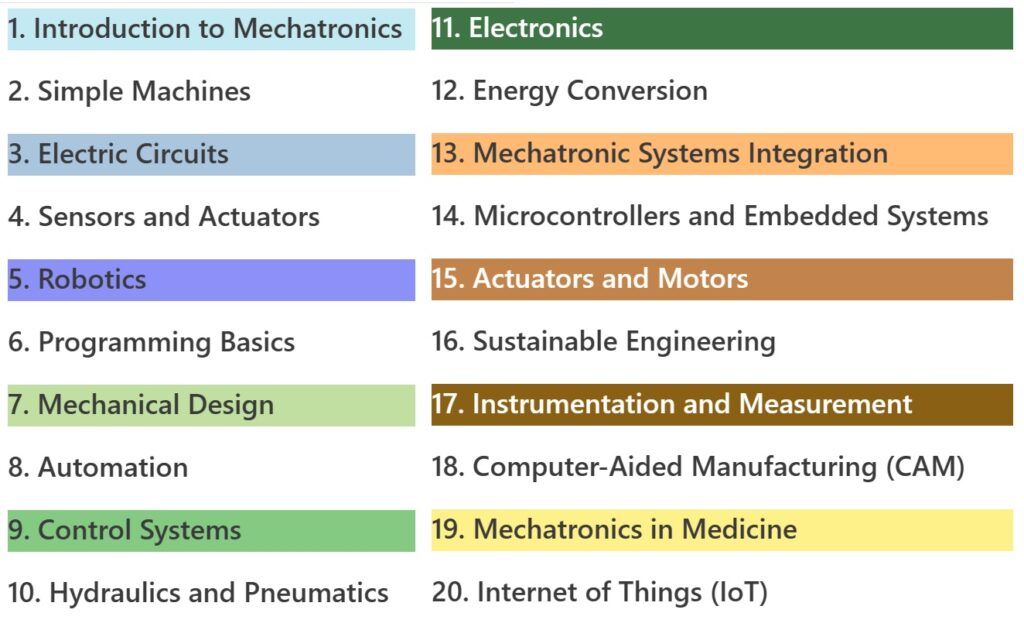
Click the simple table below to view the FULL LENGTH Mechatronics Course for Teens OVERVIEW
DISCLAIMER – This course is put together from various sources. Although the content of the course, and the questions are written and designed by Total Electrical Training, however none of the video tutorials in this course are made by us, or anyone affiliated with us. Although we’ve compiled the videos to enhance your learning of the relevant lesson, this does not mean Total Electrical Training is validating or promoting the creators of those videos or the content of their channels.
This Lessons Contains: READING, VIDEOS, QUESTIONS, and A HANDS ON PROJECT.
Instrumentation and Measurement: An Overview
1. What is Instrumentation in Engineering?
Instrumentation in engineering refers to the science and art of measurement and control. It involves the development, deployment, and maintenance of instruments and devices that measure physical quantities such as pressure, temperature, flow, and level. The discipline is a critical aspect of engineering, playing a vital role in various industries, including manufacturing, automotive, aerospace, and healthcare.
Instruments can range from simple devices like thermometers and pressure gauges to complex systems such as automated control systems in chemical plants. The primary objective of instrumentation is to ensure the accurate and reliable measurement of physical parameters, which is essential for monitoring, control, and optimisation of processes.
Instrumentation engineering encompasses several key areas, including sensor technology, signal processing, data acquisition, and control systems. It requires a multidisciplinary approach, integrating knowledge from electrical, mechanical, and computer engineering, as well as physics and materials science. The field has evolved significantly with advances in digital technology, enabling more precise and automated measurement and control systems.
2. How Are Measurements Taken in Mechatronic Systems?
Mechatronic systems integrate mechanical, electrical, and computer engineering to create complex, automated systems. These systems rely heavily on accurate and reliable measurements to function correctly. The measurement process in mechatronic systems typically involves the following steps:
a. Sensing
The first step in taking measurements is sensing, which involves detecting physical quantities such as temperature, pressure, position, and velocity. Sensors are the primary devices used for this purpose. They convert physical phenomena into electrical signals that can be processed and analysed. For example, a thermocouple converts temperature differences into a voltage that can be measured and interpreted.
b. Signal Conditioning
Once a sensor has detected a physical quantity, the resulting signal often requires conditioning before it can be further processed. Signal conditioning involves amplifying, filtering, or otherwise modifying the sensor signal to ensure it is suitable for analysis. This step is crucial for removing noise and improving the accuracy of the measurement.
c. Data Acquisition
Data acquisition involves collecting, digitising, and storing the conditioned signals. This process is typically handled by a data acquisition system (DAQ), which includes hardware and software components. The DAQ system samples the analogue signals from the sensors, converts them into digital format, and stores them for further analysis. This step is essential for converting real-world measurements into a format that can be processed by computers.
d. Data Processing and Analysis
The final step involves processing and analysing the acquired data. This may include filtering, averaging, and other mathematical operations to extract useful information. In mechatronic systems, data processing often involves real-time analysis to provide feedback for control systems. For example, in a robotic arm, position sensors provide real-time feedback to the control system, enabling precise movements.
3. What is the Significance of Calibration?
Calibration is a critical aspect of instrumentation and measurement, involving the comparison of a measurement device with a known standard to ensure accuracy. The purpose of calibration is to identify and correct any discrepancies between the measured values and the true values.
a. Ensuring Accuracy
Calibration ensures that instruments provide accurate measurements, which is essential for quality control and safety. Inaccurate measurements can lead to faulty products, process inefficiencies, and even hazardous situations. For example, in the pharmaceutical industry, accurate measurements are crucial for ensuring the correct dosage of active ingredients in medications.
b. Traceability
Calibration establishes traceability to national and international standards, providing a documented record of an instrument’s accuracy. This traceability is vital for compliance with industry regulations and standards. For example, ISO 9001, a widely recognised quality management standard, requires regular calibration of measuring instruments to maintain traceability.
c. Longevity and Reliability
Regular calibration can extend the life of measurement instruments by identifying potential issues early. It helps in maintaining the reliability and consistency of measurements over time. For instance, in a manufacturing plant, regular calibration of pressure gauges and flow meters ensures that the process parameters remain within specified limits, preventing equipment wear and tear.
d. Cost Savings
Although calibration requires an upfront investment, it can lead to significant cost savings in the long run. Accurate measurements help in optimising processes, reducing waste, and preventing costly errors. For example, in the oil and gas industry, accurate flow measurements are essential for inventory management and billing, preventing financial losses due to inaccurate readings.
4. How Do Sensors Play a Role in Measurement?
Sensors are the cornerstone of modern measurement systems, converting physical quantities into electrical signals that can be measured and analysed. They play a crucial role in various applications, from everyday household devices to complex industrial systems.
a. Types of Sensors
There are numerous types of sensors, each designed to measure specific physical quantities. Common types include:
- Temperature Sensors: Measure temperature using thermocouples, thermistors, or resistance temperature detectors (RTDs).
- Pressure Sensors: Measure pressure using piezoelectric, capacitive, or strain gauge-based sensors.
- Flow Sensors: Measure the flow rate of liquids or gases using techniques such as ultrasonic, electromagnetic, or thermal mass flow sensing.
- Position Sensors: Measure the position or displacement of objects using potentiometers, encoders, or linear variable differential transformers (LVDTs).
- Acceleration Sensors: Measure acceleration using accelerometers, which can be based on piezoelectric, capacitive, or MEMS (Micro-Electro-Mechanical Systems) technology.
b. Principles of Operation
Sensors operate based on various physical principles, such as electrical resistance, capacitance, inductance, piezoelectricity, and optics. For example, a strain gauge measures force or pressure by detecting changes in electrical resistance due to deformation. Optical sensors measure distance or position by analysing changes in light intensity or phase.
c. Integration in Systems
In modern systems, sensors are often integrated into larger networks, providing data for monitoring, control, and automation. This integration can be local, such as in a machine tool control system, or distributed, as in a smart grid. The data from sensors are often transmitted wirelessly, enabling remote monitoring and control.
d. Challenges and Considerations
While sensors are indispensable in measurement systems, they present certain challenges. These include:
- Sensitivity and Range: Sensors must be sensitive enough to detect small changes in the measured quantity but also robust enough to handle a wide range of values.
- Accuracy and Precision: The accuracy and precision of a sensor determine the reliability of the measurements. Factors such as temperature, humidity, and electromagnetic interference can affect sensor performance.
- Durability and Longevity: Sensors must withstand harsh environments, especially in industrial applications. Materials and design considerations play a crucial role in ensuring durability.
Conclusion
Instrumentation and measurement are foundational elements in engineering, enabling the accurate monitoring and control of physical processes. From simple mechanical devices to sophisticated electronic systems, instruments and sensors provide essential data that drive decision-making and optimisation. The role of calibration ensures the accuracy and reliability of these measurements, maintaining compliance with standards and regulations.
As technology advances, the field of instrumentation and measurement continues to evolve, offering more precise and automated solutions. This evolution not only enhances the efficiency and safety of industrial processes but also opens new possibilities for innovation in various sectors. Whether in healthcare, manufacturing, or environmental monitoring, the principles and practices of instrumentation and measurement remain as relevant as ever, underpinning the advancements of modern society.
Hands on Project for this Lesson – Build a Temperature Sensor with LEDs
The video below might come in helpful or you can find your own resources to create your temperature sensor.
Questions
- What is energy conversion?
- How do wind turbines convert kinetic energy into electrical energy?
- What are renewable and non-renewable energy sources?
- Why is energy efficiency important?
- Bonus Question: Research advancements in renewable energy technologies.
Ready to take a dive into Electrical Engineering to get a head start on College or University, or simply expand your DIY knowledge?
Check out our meticulously designed course in Electrical/Electronic Engineering for all walks of life, from any country. Delivered by Professor F. Tavassoli.

Buy me a Coffee
If this page has been extremely helpful, you can always buy me a digital coffee to express your thanks for the information I’ve put together to help eager minds excel in their knowledge, learning and success.
Your kind donation makes it possible for me to continue creating amazing content, courses and fulfil my dream of keeping the majority of what I make FREE and Ad FREE!!!
Thank you from the bottom of my heart, and abundant blessings to you!

Join students and professionals
from across the world increasing their knowledge of Electrical Engineering.
One email at a time
We never send spam or give your information to anyone, Privacy Policy here.
DISCLAIMER – This course is put together from various sources. Although the content of the course, and the questions are written and designed by Total Electrical Training, however none of the video tutorials in this course are made by us, or anyone affiliated with us. Although we’ve compiled the videos to enhance your learning of the relevant lesson, this does not mean Total Electrical Training is validating or promoting the creators of those videos or the content of their channels.