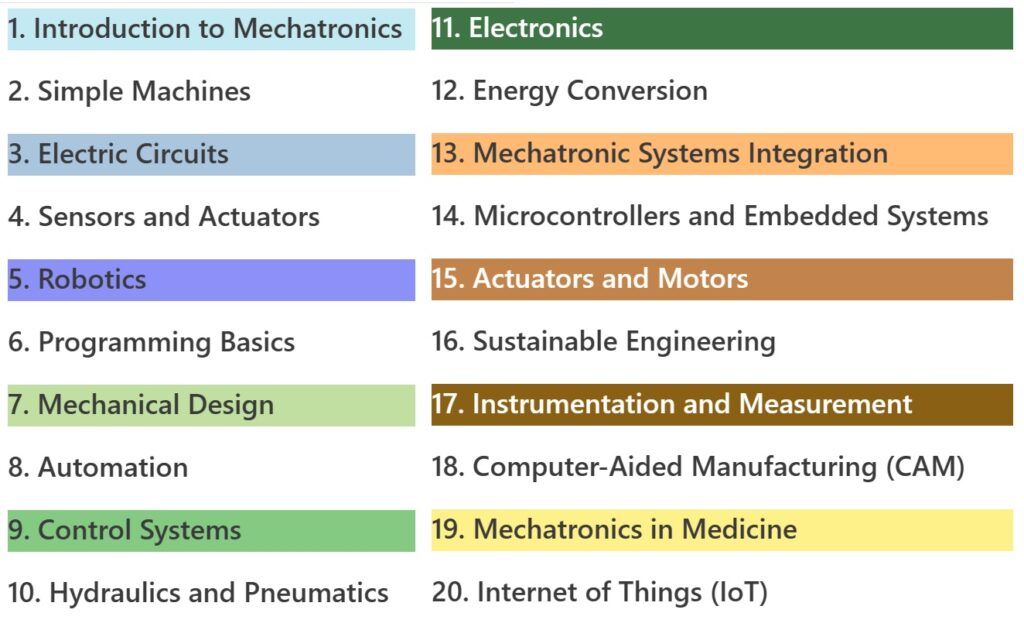
Click the simple table below to view the FULL LENGTH Mechatronics Course for Teens OVERVIEW
DISCLAIMER – This course is put together from various sources. Although the content of the course, and the questions are written and designed by Total Electrical Training, however none of the video tutorials in this course are made by us, or anyone affiliated with us. Although we’ve compiled the videos to enhance your learning of the relevant lesson, this does not mean Total Electrical Training is validating or promoting the creators of those videos or the content of their channels.
This Lessons Contains: READING, VIDEOS, and QUESTIONS.
An In-depth Exploration of Computer-Aided Design (CAD) and Computer-Aided Manufacturing (CAM)
Introduction
In the modern era, technological advancements have revolutionised various industries, with Computer-Aided Design (CAD) and Computer-Aided Manufacturing (CAM) standing out as pivotal tools in the realm of design and production. CAD and CAM are integral in creating precise designs and manufacturing components with high accuracy. This article delves into the world of CAD, explores the concept of CAM, and elucidates how these technologies have transformed the manufacturing landscape.
What is CAD?
Computer-Aided Design (CAD) is a technology used to create detailed 2D and 3D models of physical components and systems. CAD software provides designers and engineers with the tools to create, modify, analyse, and optimise designs with precision. The use of CAD has become ubiquitous in industries such as automotive, aerospace, architecture, and consumer electronics, among others.
CAD systems offer a variety of features, including drafting, surface modelling, solid modelling, and assembly modelling. These capabilities allow for the visualisation of a product’s geometry, the simulation of its performance, and the identification of potential issues before production. The advantages of CAD include increased productivity, improved quality, and the ability to manage complex projects efficiently.
What is CAM?
Computer-Aided Manufacturing (CAM) refers to the use of computer systems to control machinery and production processes. CAM systems convert digital models created using CAD software into physical products by generating toolpaths and instructions for automated machines, such as CNC (Computer Numerical Control) machines. These machines can include milling machines, lathes, routers, and 3D printers, among others.
CAM software is essential in modern manufacturing, as it enables the automation of production processes, leading to increased efficiency and consistency. CAM systems ensure that products are manufactured with high precision, reducing the likelihood of errors and material waste. This technology plays a critical role in industries where accuracy and repeatability are paramount, such as aerospace, automotive, and medical device manufacturing.
How Has CAM Changed the Manufacturing Industry?
CAM has profoundly impacted the manufacturing industry in several ways:
- Automation and Efficiency: One of the most significant changes brought about by CAM is the automation of manufacturing processes. Automated machinery, guided by CAM software, can operate continuously, reducing the need for manual labour and increasing production rates. This automation has led to shorter production cycles and the ability to manufacture complex components with high precision.
- Cost Reduction: By automating manufacturing processes, CAM reduces labour costs and minimises material waste. The precision of CAM systems ensures that materials are used efficiently, leading to lower production costs. Additionally, the reduction in manual intervention decreases the likelihood of human errors, further saving costs associated with rework and scrap.
- Improved Quality and Consistency: CAM systems produce components with consistent quality, as automated machines follow precise instructions without deviation. This consistency is crucial in industries where products must meet strict quality standards. CAM also allows for real-time monitoring and quality control, enabling manufacturers to detect and address issues promptly.
- Design Flexibility and Innovation: The integration of CAD and CAM systems facilitates rapid prototyping and the exploration of innovative designs. Designers can quickly iterate on concepts and produce prototypes to evaluate form, fit, and function. This capability accelerates the development process and allows for the customisation of products to meet specific customer requirements.
- Global Manufacturing and Supply Chains: CAM technology has enabled the globalisation of manufacturing. Digital models and toolpaths can be shared across geographical boundaries, allowing companies to collaborate with suppliers and manufacturers worldwide. This global approach enhances the efficiency of supply chains and enables businesses to access specialised manufacturing capabilities.
What are the Advantages of Using CAM?
The use of CAM offers numerous advantages, including:
- Increased Precision and Accuracy: CAM systems provide highly accurate control over manufacturing processes, ensuring that components are produced with precise dimensions and tolerances. This accuracy is crucial for industries where even minor deviations can result in product failure.
- Enhanced Productivity: Automation through CAM reduces the need for manual intervention, allowing machines to operate continuously. This leads to increased production rates and the ability to meet high-volume demands.
- Reduced Lead Times: The automation and efficiency of CAM systems shorten production cycles, enabling faster turnaround times for orders. This reduction in lead times is advantageous for industries with tight deadlines and those requiring quick responses to market demands.
- Consistency and Repeatability: CAM ensures that every component is manufactured to the same specifications, maintaining consistent quality across production runs. This repeatability is essential for maintaining product standards and meeting regulatory requirements.
- Cost Savings: CAM minimises material waste and reduces labour costs by automating processes. The precision of CAM systems also reduces the likelihood of errors, saving costs associated with rework and scrap.
- Flexibility and Customisation: CAM allows for the easy modification of designs and the production of customised products. This flexibility is particularly valuable in industries where products must be tailored to specific customer needs.
How Does CAM Relate to Computer-Aided Design (CAD)?
CAD and CAM are closely related technologies that together form a seamless design-to-manufacturing process. The relationship between CAD and CAM can be understood through the following points:
- Digital Model Creation: The design process begins with CAD, where engineers and designers create detailed digital models of components or systems. These models include geometric data, material properties, and other relevant information.
- Simulation and Analysis: CAD software allows for the simulation and analysis of designs, helping to identify potential issues and optimise performance. Designers can test the feasibility of their concepts and make necessary adjustments before moving to the manufacturing stage.
- Toolpath Generation: Once the CAD model is finalised, it is imported into CAM software, which generates toolpaths and instructions for automated machines. These toolpaths dictate the movements and operations of the machinery, such as cutting, drilling, or milling.
- Automated Manufacturing: The CAM-generated instructions are sent to CNC machines or other automated equipment, which execute the manufacturing process. The precision of CAM ensures that the final product matches the CAD model’s specifications.
- Quality Control and Feedback: Throughout the manufacturing process, CAM systems can monitor quality and provide feedback. Any discrepancies between the CAD model and the manufactured product can be identified and corrected, ensuring that the final product meets the desired standards.
- Integration and Collaboration: CAD and CAM systems are often integrated into a unified platform, allowing for seamless collaboration between design and manufacturing teams. This integration streamlines workflows, reduces the potential for errors, and enhances communication throughout the product development cycle.
Conclusion
CAD and CAM have transformed the way products are designed and manufactured, offering unparalleled precision, efficiency, and flexibility. The integration of these technologies has revolutionised industries, enabling the production of complex components and customised products with consistent quality. As technology continues to advance, the capabilities of CAD and CAM are expected to expand further, driving innovation and shaping the future of manufacturing.
In summary, CAM has brought about significant changes in the manufacturing industry by automating processes, reducing costs, improving quality, and facilitating global collaboration. The advantages of CAM, including increased precision, productivity, and flexibility, make it an indispensable tool in modern manufacturing. The relationship between CAD and CAM is integral, as these technologies work together to create a seamless design-to-manufacturing workflow, enabling the efficient and accurate production of high-quality products.
There is no hands on project for this lesson.
Questions
- What is CAM?
- How has CAM changed the manufacturing industry?
- What are the advantages of using CAM?
- How does CAM relate to computer-aided design (CAD)?
- Bonus: Research the future trends in CAM.
Ready to take a dive into Electrical Engineering to get a head start on College or University, or simply expand your DIY knowledge?
Check out our meticulously designed course in Electrical/Electronic Engineering for all walks of life, from any country. Delivered by Professor F. Tavassoli.

Buy me a Coffee
If this page has been extremely helpful, you can always buy me a digital coffee to express your thanks for the information I’ve put together to help eager minds excel in their knowledge, learning and success.
Your kind donation makes it possible for me to continue creating amazing content, courses and fulfil my dream of keeping the majority of what I make FREE and Ad FREE!!!
Thank you from the bottom of my heart, and abundant blessings to you!

Join students and professionals
from across the world increasing their knowledge of Electrical Engineering.
One email at a time
We never send spam or give your information to anyone, Privacy Policy here.
DISCLAIMER – This course is put together from various sources. Although the content of the course, and the questions are written and designed by Total Electrical Training, however none of the video tutorials in this course are made by us, or anyone affiliated with us. Although we’ve compiled the videos to enhance your learning of the relevant lesson, this does not mean Total Electrical Training is validating or promoting the creators of those videos or the content of their channels.